
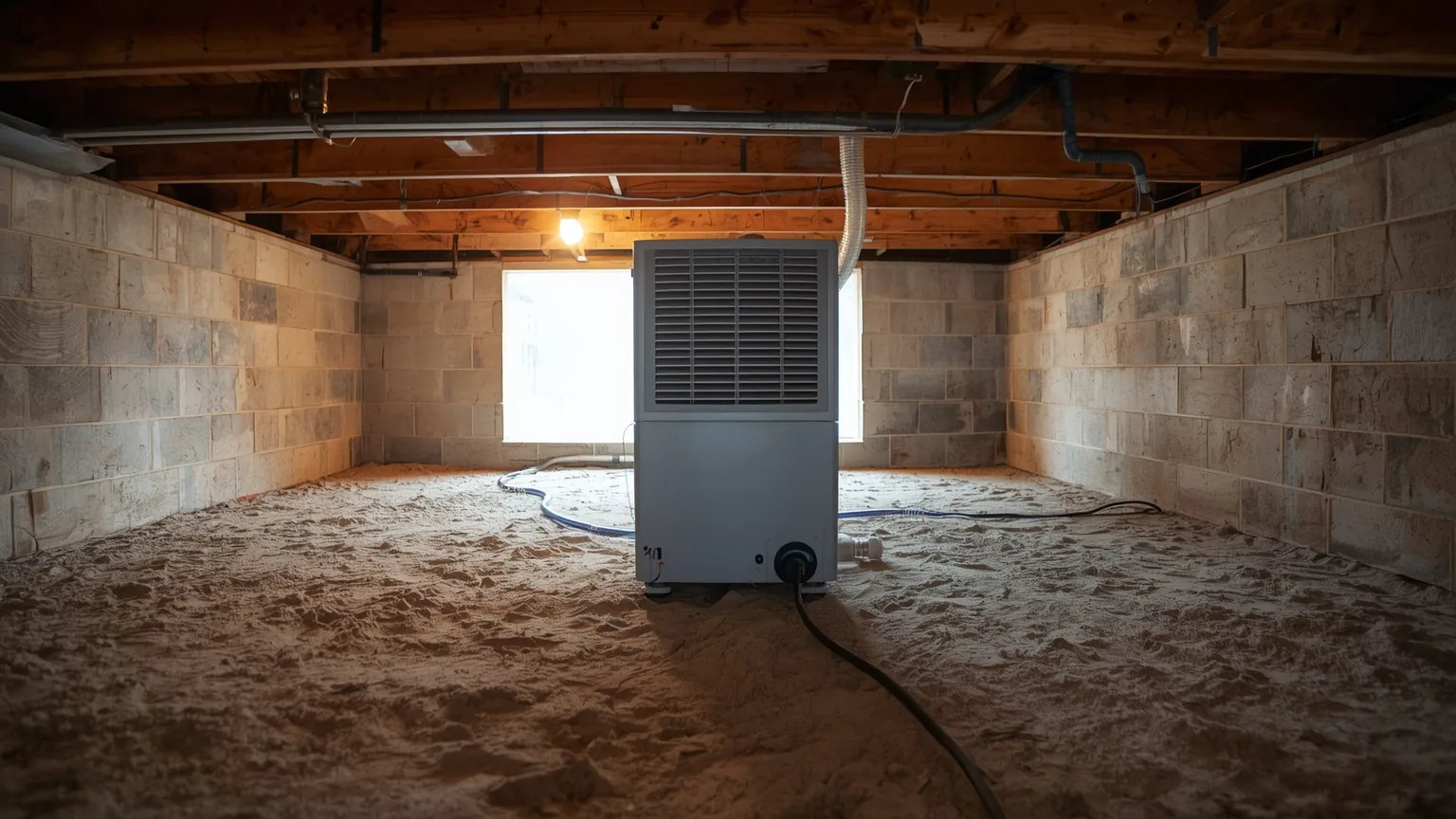
This gets framed as a choice between two products. It is really a question of sequence, and getting it backwards produces an appliance that runs constantly and achieves very little.
Should I get a dehumidifier or encapsulate the crawl space?
In most cases, seal first and condition second — because a dehumidifier in a vented crawl space is attempting to dry outdoor air coming through open foundation vents. It will run continuously, cost money to operate and never win. Once the space is sealed, a correctly sized dehumidifier is one of four methods Virginia's code accepts for conditioning it.
Why does a dehumidifier struggle in a vented crawl space?
Because the space is connected to the outdoors by design. Every pint the unit removes is replaced by more humid air through the vents. In a Virginia summer that supply is effectively unlimited — the area takes 13.10 of its 43.60 annual inches of precipitation in June through August, and the air in that period is warm enough to carry a great deal of moisture.
The unit is not faulty. It is being asked to dehumidify the atmosphere.
Is a dehumidifier ever the right standalone answer?
Occasionally, yes. If a crawl space is already effectively sealed — vents closed, sound ground cover in place — and the remaining issue is humidity, then adding conditioning is exactly the right and cheapest next step. There is no reason to rebuild a system that is mostly there.
It can also be a reasonable interim measure while a larger scope is being planned or budgeted, provided everyone is honest that it is interim.
What size unit does the code require?
Where dehumidification is the chosen conditioning method for a sealed crawl space, Virginia specifies 70 pints of moisture removal per day for every 1,000 square feet of crawl space floor area, under item 58 of 13VAC5-63-210. The model International Residential Code says only "sized in accordance with manufacturer's specifications", so this is a Virginia-specific figure worth knowing.
The arithmetic is straightforward: 1,200 square feet points to at least 84 pints per day, 2,000 square feet to at least 140.
Can I use a household dehumidifier?
It is a poor fit. Consumer units are designed for conditioned rooms, generally rely on a reservoir someone empties, and lose efficiency at the temperatures a crawl space actually runs at. Nothing in a crawl space gets emptied reliably, because nobody goes down there. Dedicated units are built for continuous unattended operation and drain permanently by gravity or a condensate pump.
What is the honest order of work?
- Resolve liquid water — drainage or grading. Nothing else matters until this is done.
- Repair what the water damaged — before a liner covers the access to it.
- Seal — ground cover, wall liner, vents closed.
- Condition — dehumidification or another accepted method, sized properly.
Buying step four first is common, and it is why some homeowners conclude dehumidifiers do not work. Our moisture control page covers how the source is identified before any of this is chosen.