
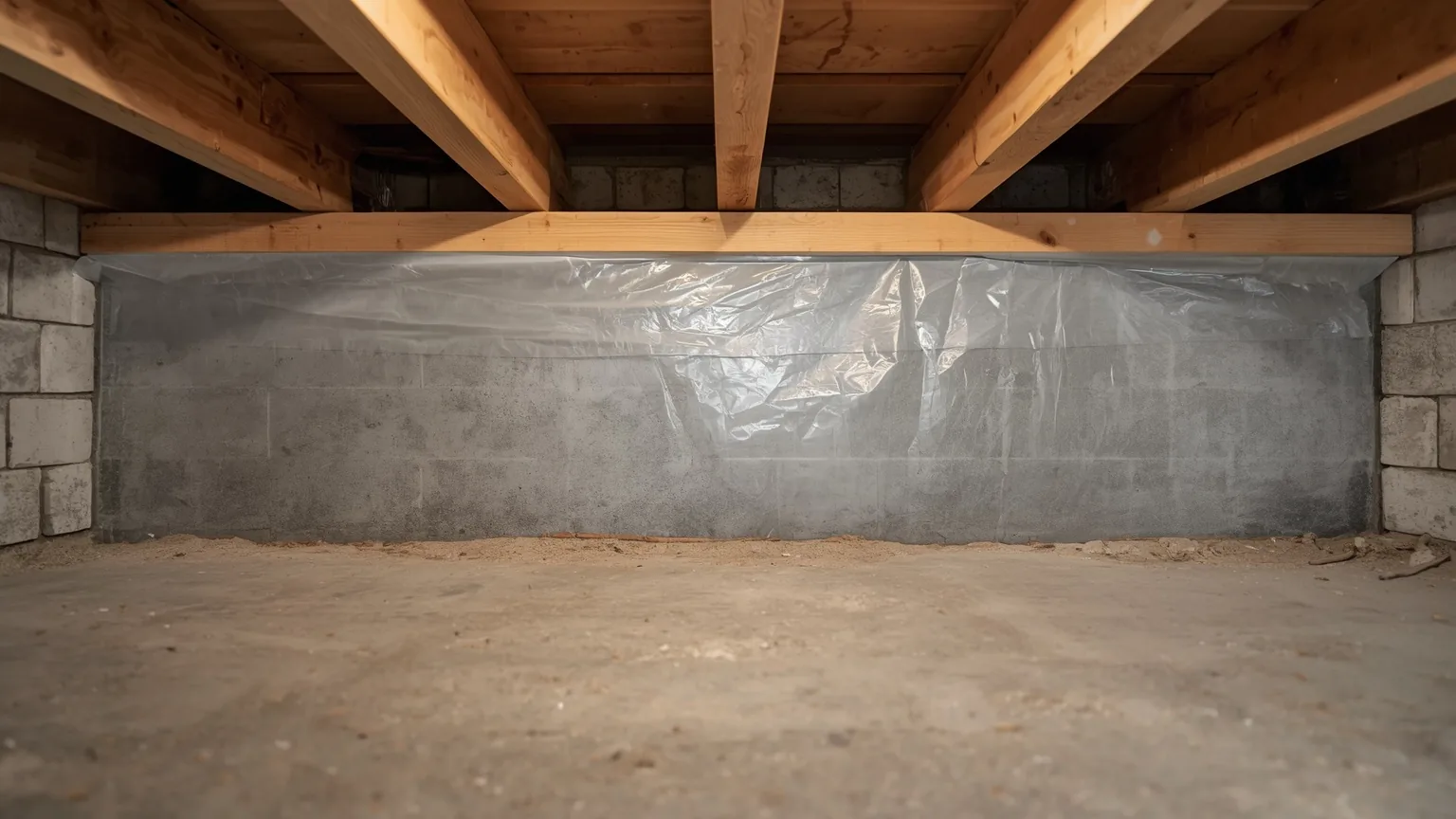
Yes — but only when it is finished. Sealing a crawl space without conditioning it is a half-built system, and Virginia's code is unusually explicit about that.
Does encapsulation reduce crawl space humidity?
It does, by removing two of the three moisture sources: evaporation from bare soil, and humid outdoor air entering through open vents. What it does not do by itself is remove moisture already in the sealed space, or moisture that continues to find its way in. That is why conditioning is a separate, required step rather than an upsell.
What does Virginia require after the space is sealed?
Section R408.3 of the Virginia Residential Code requires an unvented crawl space to have one of four things:
- Continuously operated mechanical exhaust at 1 cubic foot per minute for each 50 square feet of crawl space floor area, with an air pathway to the common area and perimeter walls insulated.
- A conditioned air supply sized to deliver 1 cubic foot per minute for each 50 square feet of under-floor area, with a return air pathway and perimeter walls insulated.
- A plenum arrangement in existing structures where the under-floor space is used as a plenum.
- Dehumidification, sized to a capacity Virginia specifies — see below.
A proposal that seals the crawl space and specifies none of these has left out a code requirement. That is the single most useful thing to check on an encapsulation quote.
How much dehumidification does Virginia require?
This is where Virginia departs from most of the country. The 2021 International Residential Code, which most states adopt broadly as written, requires only that dehumidification be "sized in accordance with manufacturer's specifications" — a clause almost any unit satisfies.
Virginia replaced it with a number. Item 58 of 13VAC5-63-210 changes Item 2.4 of R408.3 to require dehumidification sized to provide 70 pints of moisture removal per day for every 1,000 square feet of crawl space floor area. A 1,500 square foot crawl space therefore points to at least 105 pints per day.
You can check that against a quote with a calculator. If a proposal seals your crawl space and specifies a unit well under that figure, the question is which of the four methods the design is relying on.
Why does sealing alone sometimes make things worse?
Because a sealed space with no conditioning has no route for moisture to leave. In a vented crawl space, some moisture at least exchanges with outdoor air. Close the vents, lay a liner over ground that is still damp, add nothing to remove moisture, and you have built a container. Where liquid water is present the effect is worse still, which is why water is resolved first.
How long does it take to see a difference?
Weeks rather than days, and it depends on how wet the space and the framing were to begin with. Air dries quickly; wood does not. Framing that has spent seasons above 20 percent moisture content takes time to come down, and the useful measure of success is that wood moisture reading falling and staying down through a summer — not a hygrometer reading on the day the crew leaves.
What should I ask before signing?
Which of the four conditioning methods the scope uses. If it is dehumidification, what capacity in pints per day and how that compares to 70 per 1,000 square feet of your floor area. Where the condensate drains to. And whether there is a humidity readout you can see without crawling underneath — because equipment in a space nobody visits fails silently. Our dehumidifier page works through the sizing.