
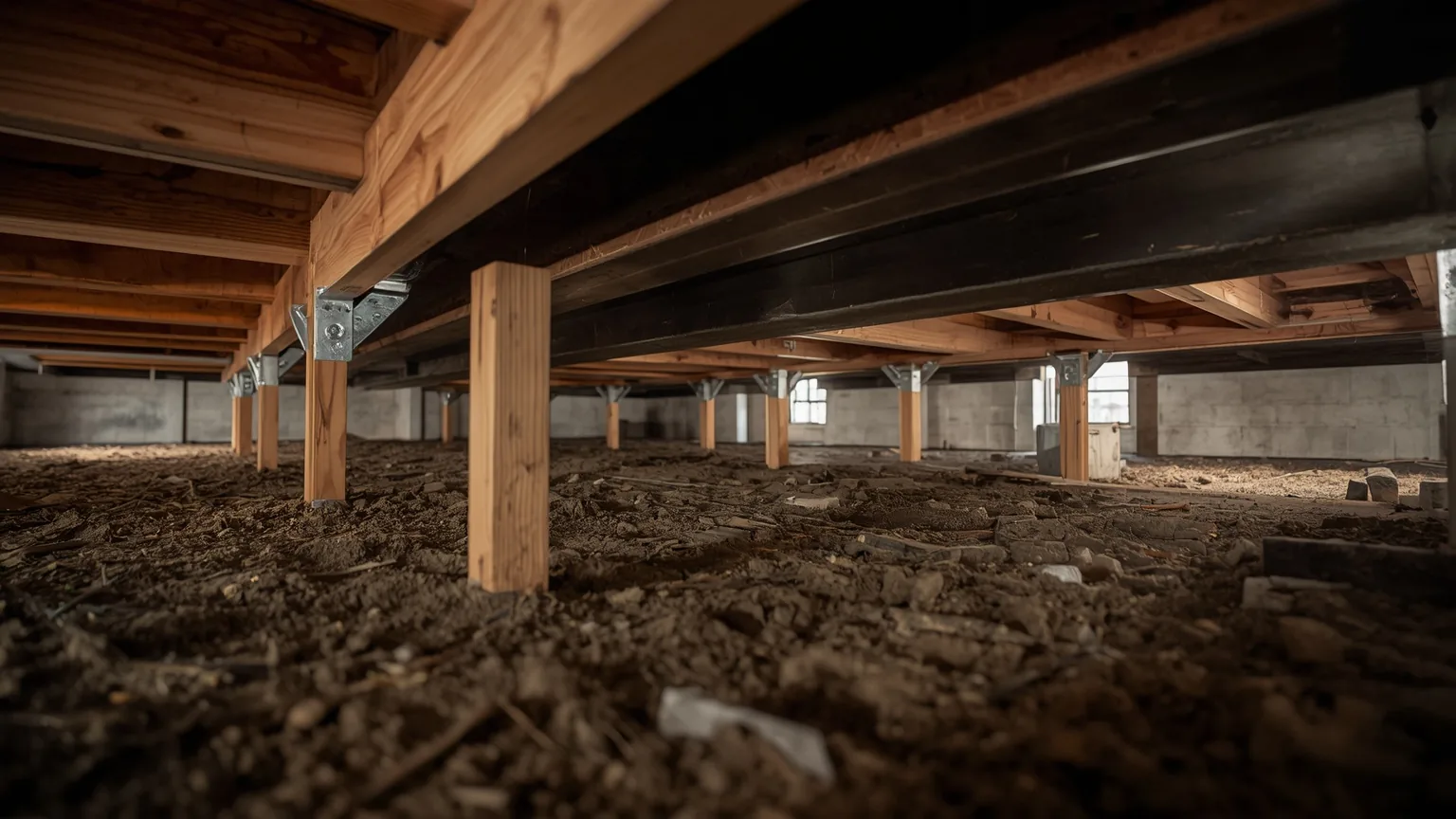
Both get sold by the same kinds of firm, both involve someone under your house, and they address different problems with different causes and very different costs.
What is the difference between crawl space repair and foundation repair?
Crawl space repair addresses the wood structure and supports inside the crawl space — joists, girders, sill plates, posts and their footings — almost always after moisture has damaged them. Foundation repair addresses the foundation itself: walls, footings and piers that have cracked, settled or moved, usually because of what the soil beneath them is doing.
How can I tell which problem I have?
The clues differ, though they can appear together:
- Points to crawl space repair: springy or soft floors over a wide area, visible decay or dark staining on joists, insulation fallen away, damp framing, damage concentrated near a known moisture source.
- Points to foundation repair: stair-step cracking in masonry, doors and windows out of square across a whole side of the house, visible movement or bowing in a foundation wall, exterior cracks that run through the structure rather than through finishes.
- Points to both: a localized dip in the floor over a settled pier — the pier is a foundation element, and the framing above it may have been overstressed as a result.
Why does moisture cause one and not the other?
Because they fail by different mechanisms. Wood decays: sustained moisture above roughly 20 percent moisture content allows fungal growth, which softens framing and reduces what it can carry. That is a crawl space repair problem and it is what most damp crawl spaces eventually produce.
Foundations move because soil moves — shrinking, swelling, consolidating or eroding beneath a footing. Water is often involved in that too, but the failure is geotechnical rather than biological, and correcting it is a different discipline.
Does local geology matter here?
It does, and Richmond is an unusually clear case. The city sits on the Fall Line, where the hard crystalline rock of the Piedmont meets the softer sediments of the Atlantic Coastal Plain — the reason the James River's gradient jumps from 1 to 2 feet per mile above the Fall Zone to roughly 14 feet per mile through it.
That boundary runs through the metro rather than around it. Houses west and north generally sit on clay-rich material weathered in place from rock; houses east and south sit on layered sands, gravels and clays. The two grounds move differently and drain differently, which is one reason a diagnosis borrowed from a neighbor is not worth much.
Who should assess it?
For contained framing damage — a soft joist, a post to reset — a competent contractor's inspection is appropriate. Where the foundation itself may have moved, where several bays are affected, or where a girder has deflected noticeably, a structural engineer should specify the repair before anyone builds anything.
An engineer is an independent cost with no product to sell, which is precisely what makes the report useful. A contractor proposing significant structural work with no engineering input is guessing at your expense.
Does it matter which one I call it?
For getting a useful quote, yes. Describing springy floors as "foundation problems" tends to summon a foundation contractor who will assess the foundation, find it broadly sound, and either walk away or propose foundation work you may not need. Describing what you actually observe — where the floor moves, whether wood looks damp, whether masonry is cracked — gets you the right trade.
Our crawl space repair page covers what an inspection should produce, and the cost page covers why quotes for this work vary so widely.