
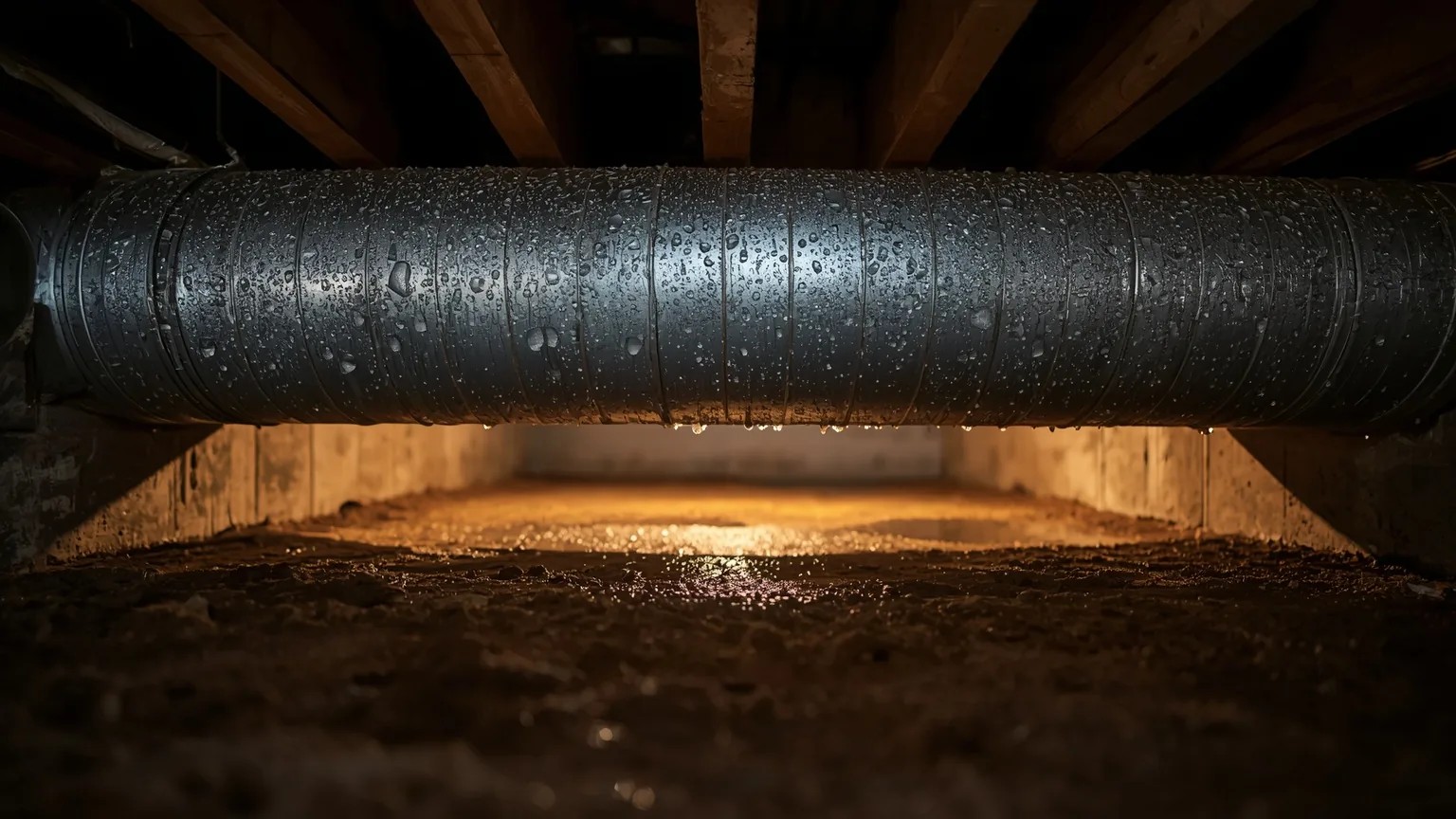
Almost nobody discovers a crawl space problem by going into the crawl space. It gets noticed in the rooms above, usually months after it started.
What are the first signs of a crawl space moisture problem?
A musty smell that cleaning does not shift, floors that feel soft or springy, doors that stop latching cleanly, and visible condensation on ducts or pipes underneath. Any one of these is worth investigating. Together they describe a space that has been holding moisture long enough to affect the structure above it.
Why does a crawl space smell reach the living space?
Because air moves upward through a house. A real share of what circulates on the ground floor entered from the crawl space first, drawn up through floor penetrations and framing gaps. That is why a smell that seems to come from nowhere in particular, and that returns after cleaning, is worth tracing downward rather than treating at the source you can reach.
Why is it worse in August than after a heavy storm?
Because the moisture is arriving as air, not as rain. Warm air carries far more moisture than cool air. When summer air comes through the foundation vents and meets ductwork, water lines and the underside of the subfloor sitting below its dew point, that moisture leaves the air and condenses on those surfaces.
The seasonal shape here makes it worse. On the 1991–2020 normals for Richmond International Airport, the area takes 43.60 inches of precipitation a year — and 13.10 of those inches fall in June, July and August alone, in the part of the year when the mean temperature is 77.4°F against an annual mean of 58.9°F. Wet ground and hot saturated air arrive together.
What should I look for underneath?
If you can get in safely, these are the observations worth making:
- Insulation hanging out of the joists. Batts absorb moisture, gain weight and let go. Once hanging, they have stopped insulating and are holding damp against wood.
- Beading on ducts and pipes. Condensation you can photograph — the mechanism happening in front of you.
- Darkened or streaked framing. Staining that follows a pattern rather than a spill.
- Standing water, or ground that stays wet. A different category of problem, covered in standing water.
- A barrier that has slipped, torn or was never sealed. Common, and it means the ground is contributing more than anyone assumed.
How wet is too wet?
The number that matters structurally is the moisture content of the wood, not the humidity of the air. Framing becomes vulnerable to fungal decay at around 20 percent moisture content. A single humid week does nothing; months spent above that threshold is what causes damage, which is the shape of a Virginia summer.
This is why a proper evaluation meters the framing in several places rather than reading a hygrometer once and pronouncing.
Does a musty smell mean there is a health problem?
We do not make health claims and will not start here. What can be said is that a persistent musty smell is a reliable indicator of sustained moisture, and sustained moisture damages buildings. That is reason enough to diagnose it. Anything about health belongs with a medical professional, not a contractor.
What should I do first?
Write down what you notice and when. Whether the smell is year-round or seasonal, whether water appears during rain or a day later, whether the floor has always had give or developed it. That record costs nothing and is genuinely diagnostic — it separates a ground-vapor problem from an air problem from a liquid-water problem before anyone charges you to find out. Then get someone underneath with a moisture meter. Our moisture control page covers what that evaluation should produce.