
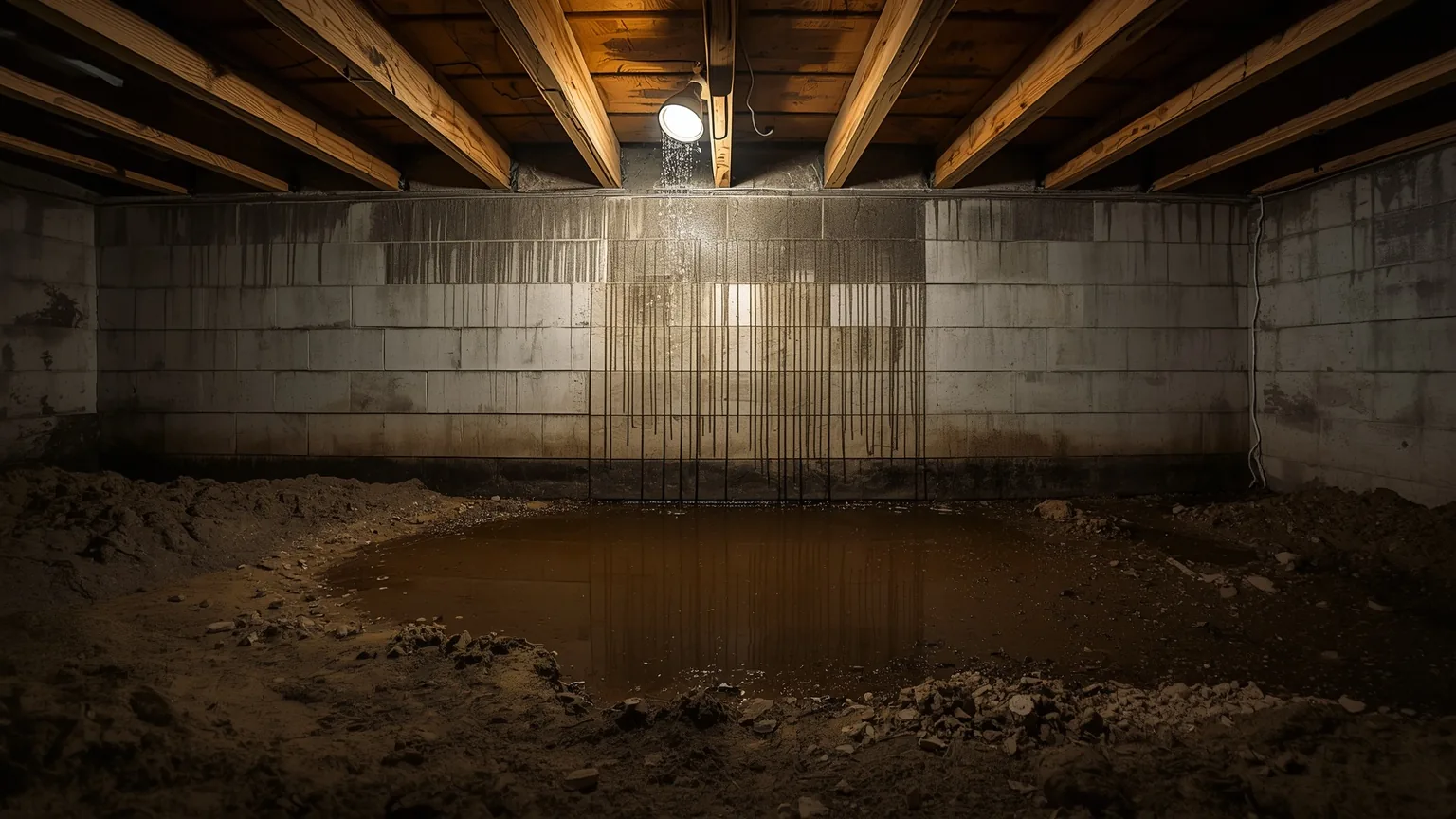
Standing water under a house comes from a short list of sources, and you can narrow that list considerably before anyone visits — just by noticing when it appears.
What causes standing water in a crawl space?
Four things, in rough order of how often they turn out to be responsible: surface runoff from gutters, downspouts and grading; groundwater rising or moving laterally through the soil; plumbing failures under the floor; and a crawl space floor sitting lower than the surrounding ground with no drainage route out. Each calls for different work.
How does the timing tell me which one it is?
This is the most useful free diagnostic available:
- Within an hour or two of rain, receding soon after — surface runoff. Gutters, downspouts and grading. The cheapest category to fix.
- A day or more after rain, or with no recent storm — groundwater. Water moving through the ground rather than over it, which points to interior drainage.
- No relationship to weather at all — plumbing. A supply line or waste pipe, and worth eliminating early because it is a different trade entirely.
- Seasonal, arriving in the wet part of the year and staying — a water table that rises seasonally.
Write down what you observe with dates. It is genuinely valuable information and most homeowners already have it without realizing.
Why does water arrive a day late around here?
Because of what the local ground does with it. The Bourne soil series was formally described from a site in Goochland County, inside this metro, and it is a fragipan soil — a dense, brittle subsurface layer water struggles to pass through. The USDA puts depth to that fragipan commonly at 18 to 35 inches and describes the series as having slow internal drainage and slow or very slow permeability.
A dense layer beginning a foot and a half down is at crawl space depth. Water reaching it does not keep going down; it spreads sideways and sits. That is the mechanism behind water appearing under a house a day or two after the rain rather than during it, then taking its time to leave.
Does Virginia's code say anything about this?
It does, in a provision rarely quoted. R408.6 allows the under-floor grade to sit at the bottom of the footings in the normal case. But where there is evidence that the groundwater table can rise to within 6 inches of the finished floor at the building perimeter, or that surface water does not readily drain from the site, the crawl space grade must be as high as the outside finished grade — unless an approved drainage system is provided.
The code anticipates problem sites and names a drainage system as the remedy. If your site has that evidence, drainage is the code's own answer rather than an upsell.
What should I check outside first?
Walk the perimeter during or just after heavy rain, which is unglamorous and more informative than anything you can do from inside. Look for downspouts discharging at the foundation, gutters overflowing, ground that has settled back toward the house, and driveways or patios pitching inward. These are common, cheap to correct, and responsible for a large share of wet crawl spaces.
A proposal for interior excavation made without anyone having walked the outside has skipped the step that might have solved it for a fraction of the cost.
Can I just seal the crawl space instead?
No, and this is the most expensive mistake available in this trade. A liner over an active water source hides the water, holds it against the ground and the foundation, and removes the evaporation that was at least partly clearing it. Water is resolved first. That sequence is covered in this post, and the wider approach on our waterproofing page.